9th Circuit Denies Rehearing En Banc in Montana Contribution Limits Appeal

9th Circuit Denies Rehearing En Banc in Montana Contribution Limits Appeal

It’s been six months since a three-judge panel of the Ninth Circuit Court of Appeals, on a 2-1 vote, upheld Montana’s right to limit campaign contributions. After Citizens United, the only governmental interest strong enough to over-ride the First Amendment is quid pro quo corruption or the appearance of corruption, and the government had to show “objective evidence” of that to justify a limit on speech. See McCutcheon v. FEC, 134 S. Ct. 1434, 1441, 1444–45 (2014); Citizens United v. FEC, 558 U.S. 310, 359 (2010).

The question in Lair was what was “objective evidence” of quid pro quo corruption: was evidence about lobbying or campaign contributions enough to show corruption, even though the Supreme Court held in Citizens United and McCutcheon that “ingratiation” or “access” was not corruption or its appearance? For example, Chief Justice Roberts wrote in McCutcheon:

We have said that government regulation may not target the general gratitude a candidate may feel toward those who support him or his allies, or the political access such support may afford. “Ingratiation and access . . . are not corruption.” Citizens United v. Federal Election Comm’n, 558 U. S. 310, 360 (2010). They embody a central feature of democracy—that constituents support candidates who share their beliefs and interests, and candidates who are elected can be expected to be responsive to those concerns.

The original panel decision last October ruled that, to prove “objective evidence” of corruption, Montana only had to show objective evidence of lobbying activity or campaign contributions. Today, the entire Court of Appeals refused to rehear the case en banc.

There was a dissent by five judges, written by Judge Sandra Ikuta and a concurrence with the denial by two. Judge Ikuta’s dissent stressed that the cases on which the original panel majority relied were handed down before recent Supreme Court cases like McCutcheon and Citizens United. The concurrence, written by Judges Raymond Fisher and Mary Murguia, argued that the original panel had respected the newer Supreme Court precedents in its decision.

The denial’s dissent and concurrence have actually set up a set of very timely and important questions for the Supreme Court. Professor Richard Hasen, host of the Election Law Blog, has already posted about the denial of rehearing. Hasen, who has defended contribution limits in the past, believes that the dissents and concurrence have identified an issue that the Supreme Court might likely choose to review:

Judge Ikuta’s dissent hits on an unresolved question. There are a number of campaign contribution cases, such as Shrink Missouri, decided when the Court was much more deferential to campaign finance regulations and much more willing to let states and localities support contribution limits with a little bit of evidence. No doubt these cases are in tension with McCutcheon, but McCutcheon did not overrrule these cases. And so judges like today divide on what to do.

Nevertheless, Hasen posits that a reversal of the Ninth Circuit’s decision “would almost certainly be to call into question all campaign contribution limits (as indicated in the Judge Fisher/Judge Murguia response).” He doesn’t think the Supreme Court would want to do that much and so might be unlikely to grant certiorari. Hasen does not mention that both Citizens United and McCutcheon are controversial cases, but that is likely behind his thinking.

On the other hand, this is a “clean” case, in the sense that there aren’t a lot of extraneous procedural or other issues that prevent a direct Supreme Court review of the critical legal question. The primary method for convincing the Supreme Court to review a decision is a division (“conflict”) among the circuit courts of appeal. The reason for this is to prevent “forum-shopping” between federal courts when litigants see that decisions in one Circuit are favorable and another not so much. Uniformity of the law across the country is primary among the interests of the Supreme Court.

And the Supreme Court has always been fairly protective of its own decisions, and may choose to use this case to educate lower court judges on this fundamental question. McCutcheon is a particularly recent decision, and, in Part V of its opinion, the Court parsed at some length the corruptive effect of campaigns contributions and lobbying:

The Government argued that there is an opportunity for corruption whenever a large check is given to a legislator, even if the check consists of contributions within the base limits to be appropriately divided among numerous candidates and committees. The aggregate limits, the argument goes, ensure that the check amount does not become too large. That new rationale for the aggregate limits—embraced by the dissent, see post, at 15–17—does not wash. It dangerously broadens the circumscribed definition of quid pro quo corruption articulated in our prior cases, and targets as corruption the general, broad-based support of a political party.

But that’s exactly what the Ninth Circuit decision would do. The Fisher/Murguia concurrence, for example, gave two examples of legislators speculating about large contributions to the Republican Party. Slip op. 25. This is a fundamental divide about the corrupting effect of campaign contributions, just four years after the Supreme Court dealt with the same question in McCutcheon. 

This one might be more important than its focus on the quantum of evidence would indicate. And Jim Bopp, the legendary attorney who brought this case, just messaged me to say that he definitely would ask the Supreme Court to grant cert.

The Quickest Way To Censorship And Public Incivility Is To Ask If Everything is Hate Speech

The Quickest Way To Censorship And Public Incivility Is To Ask If Everything is Hate Speech

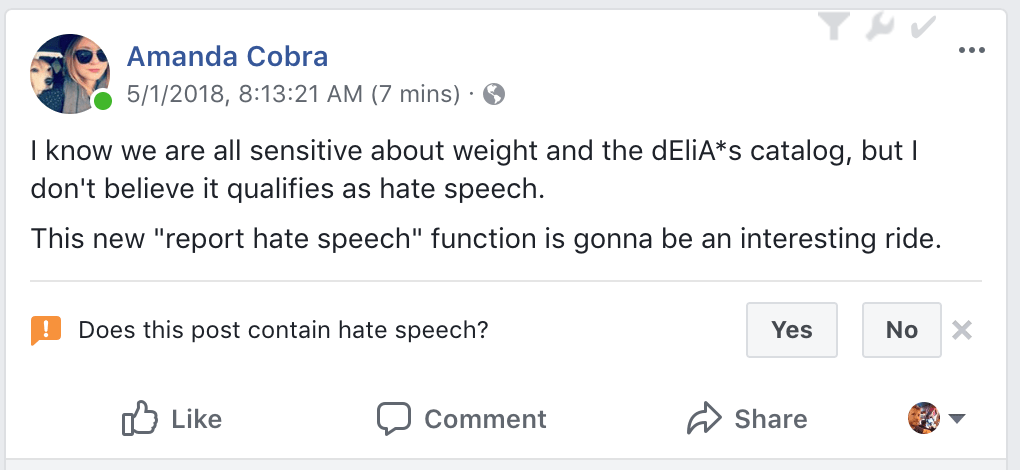
I’ve been planning to write again about Facebook’s efforts to censor its major product: what people post. Facebook is rolling out so much at once, though, that it’s hard to keep up, and harder to craft the lengthy posts necessary to understand the impact of today’s technology on First Amendment advocacy questions. But today’s Facebook screwup, asking people if every news item or post is “hate speech,” has to be explained in historical and technical context to understand how massively injurious it will be.
Screen-Shot-2018-05-01-at-8.20.51-AM

(From Ars Technica)

[Update: Facebook has now responded that this was not a “mistake” per se. Vice-President of Product Management Guy Rosen said that it was “a test and a bug” which was visible for only 20 minutes. Nverse‘s Danny Paez points out, quite reasonably, that “A prompt like “Does this contain hate speech?” may seem silly when it’s under something benign, but it could be a way for the company to train an algorithm to think more like a human.” But the rest of my much longer post below is that “do we want machines to think like humans? Not if we don’t want human biases incorporated in our algorithms.”]

[More Updates: Wired offers an opposing view, asking for more human intervention but recognizing a role for AI, from a researcher who has studied hate speech. And C|Net offers a report from yesterday’s F8 Facebook conference on Facebook’s AI programs.  “‘We have a lot of work ahead of us,’ Guy Rosen, vice president of product management, said in an interview last week. ‘The goal will be to get to this content before anyone can see it.'”]

In short, Facebook appears to be promoting a “reform” that will lead to increasing amounts of public incivility and possibly unfounded and unsupportable regulation.

Exactly the opposite of what it says it wants. And decidedly unscientific.

Some of what Facebook has done is at least arguably reasonable. Their attempt to define “community standards” is far better than Justice Potter Stewart’s “I know it when I see it” standard for obscenity. Jacobellis v. Ohio, 384 U.S. 184, 197 (1964). When you remember that Facebook’s anonymous drafters have to deal across many different cultures with different levels of awareness, most of its community standards make sense.

The best way to understand what Facebook is up to now, however, is to watch a Roomba robo-vacuum explore and clean a room for the first time. It starts out spinning in a circle for a while, then tentatively bumps out in one direction until it hits something, spins again and moves somewhere else, and so on, for an amazingly long time compared to a human “sanitary engineer,” who simply looks, recognizes and vacuums. It is the beginning of a search by a machine (or those responsible for machine thinking) for a path through the typically-chaotic environment created by unpredictable humans. Another example is how robot engineers learned that children near a robot were a highly-dangerous environment — for the robot, which had to be protected from the kids.

Many people looking at how to police “harmful speech,” Mark Zuckerberg included, talk about “AI” (Artificial Intelligence) being the holy grail of dealing with vast amounts of speech, hateful or otherwise. And the latest “flavor of the month” in AI for this topic is “machine learning.” Machine learning is simply asking a machine to analyze massive amounts of data to predict future outcomes.

Machine learning is, in fact, likely to be a very good way to look at human speech and actions to identify root causes of later actions that may not be intuitively and immediately obvious. Because they are not subject to “confirmation bias,” primacy, perseverence, and many other human tendencies to misread or ignore evidence, well-programmed machines can start with a blank slate, looking for correlations and factors that would likely elude even determined human observers.

I’m not unsympathetic to the difficulty of Facebook’s self-imposed goal. I started “coding” in the 1960’s, as part of a California effort to promote computer and science literacy at an early age (I think it backfired in my case; I did go to college in astrophysics, but ended up a mildly-libertarian First Amendment lawyer). I have always had clients who are among the most advanced in data collection, analysis, and machine learning for use in advocacy and political activity.

You can, for example, view the movement of computer-aided analysis in advocacy in three stages: looking at the past to predict the future -> looking at the present to predict the future -> using mathematics to predict the future. In the early days of computer analysis, we looked to see cause and effect in the past. For example, we mailed (snail-mailed in those days) to a list of members of an organization that looked like ours, based on perceived characteristics; if we got a good return from that mailing, we did it again (and if we were smart, we cross-checked among lists to find newer and better lists to mail). Back in the 1970’s, the Democratic National Committee had me learn from Matt Reese, the “father of microtargeting” these lists.

Looking at the past was mostly human-guided. We looked at the results of prior tests and paid a lot of money to experts who said they could tell us what they meant. But predicting future results was mostly guesswork. And, of course, distorted by the same biases that humans — even well-trained humans — are always subject to.

In the present, better technology  has given us almost real-time results of tests. The Trump and Obama campaigns were very good at this. With massive scale and advanced technology, those data teams could target millions of fundraising and political appeals with vastly-improved precision. But it was still brute-force guesswork, for the most part, with human predictions driving analyses, which then produced more human-guided predictions.

An example: Cambridge Analytica’s “psychographic modeling” behavior. In effect, automating “psychohistory” in author Isaac Asimov’s 1950’s Foundation trilogy, algorithms that can predict human history for hundreds of years in the future. The popular OCEAN psychographic model technique was developed in the 1980’s. And it was pretty much what Matt Reese and programmer Jonathan Robbin were doing with “Claritas” in the 1970’s, categorizing mailing lists as being of “clusters” of people likely to respond to particular messages. More importantly, this type of modeling, though based on computer-aided analyses and much more accurate than earlier methods, is still subject to human biases, both in analyses of massive data and predictions based on the analyses.

Enter the (predicted and sometimes here) third wave: removing humans from the prediction process. Machine learning. Develop the algorithms necessary for the computers themselves to review the data and make predictions from it. Taking humans out of the process allows insights such as the famous “political ideology can be predicted by sales of frozen dinners.” Which is, in fact, true, if incomplete.

What is missing from most analyses of machine learning is an understanding of what separates good from bad machine learning. If all the machines do is take a quick snapshot of what’s happening, the resulting analyses are likely to be no better than what Reese and Robbin were doing five decades ago. The predictions from those analyses will be very accurate — for a very short time and in limited circumstances. The use of static machine learning analyses is simply another form of human bias: “it came from a computer, so it must be true.”

Accurate modern machine learning is an “iterative” and constantly-changing process. If analyses of data are improved by removing human biases, so are analyses of data analysis algorithms and models. And one of the elements of improved algorithms is their maintenance and improvement over time. Feedback and testing are requirements for any machine-learned result, and more importantly, for any machine-learning algorithm. What we might have felt was accurate in 2015 was likely proven wrong in 2017.

Today’s obvious Facebook mistake is not just a reversion, it’s a demonstration of exactly the wrong way to go. The trend in predicting human issue and political positions is, as shown above, to move beyond human biases. Today, Facebook mistakenly rolled out a tool that not only solicits human bias, but uses it to silence the speech of others.

Facebook is going to ask readers of its newsfeed to click a box if they think something is “hate speech.” Facebook’s Community Standards define “hate speech” as:

We do not allow hate speech on Facebook because it creates an environment of intimidation and exclusion and in some cases may promote real-world violence.

We define hate speech as a direct attack on people based on what we call protected characteristics — race, ethnicity, national origin, religious affiliation, sexual orientation, sex, gender, gender identity, and serious disability or disease. We also provide some protections for immigration status. We define attack as violent or dehumanizing speech, statements of inferiority, or calls for exclusion or segregation. We separate attacks into three tiers of severity, as described below.

Sometimes people share content containing someone else’s hate speech for the purpose of raising awareness or educating others. Similarly, in some cases, words or terms that might otherwise violate our standards are used self-referentially or in an empowering way. When this is the case, we allow the content, but we expect people to clearly indicate their intent, which helps us better understand why they shared it. Where the intention is unclear, we may remove the content.

Do they really expect people to read and understand that particular definition before they click “yes” or “no?” Or is it more likely that people will just call everything they don’t like “hate speech?”

Facebook is a private company, not a government subject to the First Amendment. In that context, Facebook is perfectly entitled to define hate speech as whatever it feels like. But, as Guidestar (which publishes copies of tax filings by tax-exempt entities) found when it tried to flag three dozen organizations as “hate groups,” mistakes can happen. Imagine your outrage if someone wrongfully accused you of being a “hate group.” Guidestar won a costly legal battle, but its new chief executive Jacob Harold “acknowledged that there were reasonable disagreements about the fairness of some of the hate-group labels.”

And, in fact, Facebook admits that mistakes have happened at Facebook’s existing “hate speech” monitoring process. ProPublica, a journalistic advocacy organization, reported in December 2017 that when it asked Facebook about 49 seemingly offensive examples of “hate speech” that remained visible, Facebook replied that 22 of the 49 decisions were “the wrong call.”

Facebook is much, much larger and stronger than Guidestar. It can undoubtedly withstand the thousands of lawsuits likely to arise from its labeling of posts as “hate speech.” But its legal position is far weaker than Guidestar’s; Guidestar won its lawsuit because it was not deemed to be engaging in “commercial speech.” Facebook won’t have that protection.

But even more important, if Facebook’s halting and mistaken efforts to use “crowdsourcing” to determine whether particular posts or ads are “objectionable content” are any indication, Facebook is headed down the wrong AI path. As shown above, modern AI analyses, especially involving machine learning, as Facebook appears to be doing, take OUT the human element, using objectively measurable standards rather than innate human biases. Facebook is doing the opposite.

By proceeding in an unscientific and biased manner, Facebook itself is encouraging a finding of “hate speech,” and thus slanting not only its actions, but likely also the reporting of how much “hate speech” actually exists. Just asking the question of humans is very likely to trigger a much higher level of positive reporting, a well-recognized phenomenon known as the “observer-expectancy” effect. Because the question is asked, and a reporting option offered, readers will think that someone must have thought it was hate speech to even ask about it. This is a “positive feedback loop” that will likely have unexpected and probably unpleasant consequences.

Again, I understand that this was a preliminary effort, and Facebook has been candid that in other countries, relying on posts to determine whether language can be “coded” threats is useful. But Facebook’s own history, as well as the well-reported development of analytical techniques using Facebook’s own type of technology, demonstrate that having people self-report “hate speech” is likely to over-report and under-report, as well as mis-report, objectionable speech. Even worse, it is probably equally likely to censor or restrict legitimate speech that someone just doesn’t like.

And that doesn’t seem at all within Facebook’s own community standards or announced mission.

Only “Authorized” Speakers Can Put “Issue Ads” on Facebook Now

Only “Authorized” Speakers Can Put “Issue Ads” on Facebook Now

Facebook just announced, in a blog post by its Vice-Presidents for Ads and Local & Pages, that only advertisers who were “authorized” could post issue advertisements on Facebook. This extends a similar restriction Facebook announced last October.

Last October, we announced that only authorized advertisers will be able to run electoral ads on Facebook or Instagram. And today, we’re extending that requirement to anyone that wants to show “issue ads” — like political topics that are being debated across the country. We are working with third parties to develop a list of key issues, which we will refine over time. To get authorized by Facebook, advertisers will need to confirm their identity and location. Advertisers will be prohibited from running political ads — electoral or issue-based — until they are authorized.

In addition, these ads will be clearly labeled in the top left corner as “Political Ad.” Next to it we will show “paid for by” information. We started testing the authorization process this week, and people will begin seeing the label and additional information in the US later this spring. …

We know we were slow to pick-up foreign interference in the 2016 US elections. Today’s updates are designed to prevent future abuse in elections — and to help ensure you have the information that you need to assess political and issue ads, as well as content on Pages. By increasing transparency around ads and Pages on Facebook, we can increase accountability for advertisers — improving our service for everyone.

Facebook is a private entity, and so is not bound by the First Amendment. It also has a history of favoritism in political activities, including helping the 2008 Obama campaign obtain (or “scrape”) and profile friend lists – which ironically is very similar to the behavior that got Cambridge Analytica (and Facebook) in trouble by scraping lots of Facebook user information. Both organizations scraped friends lists; the major difference was that the Obama campaign asked users to send their campaign messages – an example of the peer-to-peer communication that has been a mainstay of American politics at least since the classic “Abe Lincoln four-step” technique – while Cambridge Analytica just sold the information to others).

But today’s new restrictions on “issue ads” are something different. It’s difficult enough for a private company to determine when an ad is “political” when it addresses an election or a candidate. Even the U.S. Supreme Court had to relax an “express advocacy” rule that defined an electoral or candidate-related advertisement by whether it used “magic words” of “vote for” or “vote against”: “a court should find that an ad is the functional equivalent of express advocacy only if the ad is susceptible of no reasonable interpretation other than as an appeal to vote for or against a specific candidate.” FEC v. Wisconsin Right to Life, 551 U.S. 449 (2007). The Federal Election Commission generally uses a “PASO” test as to whether the ad “promotes, attacks, supports, opposes” a specific candidate or party. The IRS uses a “3 T’s” test, looking at the Timing of an ad is close to an election, the Targeting of an ad is to those who will vote in a particular election, and the Text refers to a candidate’s character or fitness for office.

It is much, much harder to determine when an “issue ad” is “political.” Issue ads, by their nature, address controversial subjects on which there are reasonable positions about which people disagree. What is “political” to one person may look completely different to another. A new study suggests that reactions to “political” choices may be hard-wired into the human brain, which is one reason it’s so difficult to change those choices:

It’s no sweat to change your mind on the accomplishments of Thomas Edison. But on topics like abortion, same-sex marriage, and immigration, people don’t budge. … The brain processes politically charged information (or information about strongly held beliefs) differently (and perhaps with more emotion) than it processes more mundane facts. It can help explain why attempts to correct misinformation can backfire completely, leaving people more convinced of their convictions.

Some people may say that Facebook isn’t censoring the ads; it will still run the ads if the sponsor is “authorized” and discloses certain information. And it responded to the Ars Technica article revealing the Facebook authorization requirement by claiming that the authentication will likely be “location-based” rather than content-based.

But if that is the emphasis, why is Facebook working with “third parties” to make a list of topics on which ads will be considered “political”? Are the topics going to be controversial, partisan, only “wedge” issues (which vary from campaign to campaign) and so on?

Will Facebook end up conducting the same kind of psychological analysis of users to determine when an ad is “political” that it criticized when Cambridge Analytica used its own, proprietary and really very odd form of remote psychoanalysis? But that would be ok because … it’s Facebook, not some scummy political consulting firm?

As with the Obama-Cambridge Analytica example and the timeless examples of biased news media coverage demonstrate, very few private censorship choices would withstand even the simplest of First Amendment review if the same actions were conducted by a governmental entity. And the reason that government is simply banned from conducting such issue analyses is that nobody, even someone as big and powerful as Facebook, can do it well. So nobody – or at least nobody with power over what other people can say, see or hear – should do it at all.

Is an “Issue Ad” a “falsely narrow dumb legalism”?

Is an “Issue Ad” a “falsely narrow dumb legalism”?

“Where the First Amendment is implicated, the tie goes to the speaker, not the censor.”

FEC v. Wisconsin Right to Life


On the Election Law mailing list, which has a high noise-to-signal ratio but often has valuable information and opinions, a debate is raging between Professor Brad Smith, a former Chairman of the Federal Election Commission and founder of the Institute for Free Speech, and a list participant named Jeff Hauser (I don’t know which Jeff Hauser this is) over a National Public Radio report on whether the National Rifle Association used contributions from Russian nationals to influence the 2016 presidential election. The NPR story says, in part, that because the NRA has different financial accounts for its different entities (what most people think of as “the NRA” is a 501(c)(4) social welfare advocacy organization, but there is also a charitable organization and a political action committee), its reporters cannot determine whether Russian money filtered through into American campaign activities. “While the NRA claims it does not receive foreign money for election purposes, the movement of its money among accounts could make it difficult, if not impossible, to track how the money is spent since it is not isolated or sequestered.”

Actually, that is an extraordinarily-ignorant statement for NPR to make, since almost all expenditures for political activities, no matter what type of organization makes them, are reportable and trackable. They must be reported to the Federal Election Commission and, if made by tax-exempt organizations reporting to the Internal Revenue Service, must be reported to the IRS. Every organization which has to report such expenditures must “isolate[] or sequester[]” the money to spend and report it compliantly. And it would be no excuse to say that one tax-exempt organization could transfer funds to another (for example, a 501(c)(3) charity, which cannot make political expenditures, could transfer the funds to a 501(c)(4) advocacy organization, which could make such expenditures), since the donating organization, if it knew or believed that its contribution would be used for political purposes, would have to report the transfer in any case, and likely would have to indicate that the funds would be used for a political expenditure. Indeed, under IRS rules, charities generally have to demonstrate that they have prohibited the use of any grants to other organizations for political purposes.

Maybe NPR was referring to the “fungibility” theory, which says that a charity will give non-political dollars to an advocacy group to free up other dollars the advocacy group can use for political purposes, but its statement is far too broad for that. Besides, the Supreme Court has soundly rejected the idea that since one part of an allied group of sister organizations (actually a term of art in tax-exempt organization law) is political active, the activity must also taint all the other members of the group. FEC v. Wisconsin Right to Life, (colloquially known as WRTL II)Indeed, the Supreme Court said that the same theory applies to protect issue ads even if the organization’s other activities are expressly political. “WRTL does not forfeit its right to speak on issues simply because in other aspects of its work it also opposes candidates who are involved with those issues.” The ads must be considered on their own merits, not “could be” tests or “context.”

More likely, NPR has fallen for the fallacy that Jeff Hauser has offered: that funds used for “issue ads” are actually used for political activities. As the Supreme Court explained in WRTL II, “a genuine issue ad [for example]… focus[es] on a legislative issue, take[s] a position on the issue, exhort[s] the public to adopt that position, and urge[s] the public to contact public officials with respect to the matter.” It does not include any “indicia of express advocacy.” Yet Hauser wrote on Jan. 20, “‘Issue ads’ are known to be a falsely narrow dumb legalism by anyone who works in electoral politics.”

Actually, the “legalism” of “issue ad” is quite narrow, because all regulation of speech must be narrowly tailored to be constitutional. And it isn’t “false” because the Supreme Court requires it to be very precise to be constitutional, as it did in 2007 in an extensive discussion in FEC v. Wisconsin Right to Life. In Footnote 7, the Supreme Court clearly explained the method to distinguish between issue ads and political ads:

   our test affords protection unless an ad is susceptible of no reasonable interpretation other than as an appeal to vote for or against a specific candidate. It is why we emphasize that (1) there can be no free-ranging intent-and-effect test; (2) there generally should be no discovery or inquiry into the sort of “contextual” factors highlighted by the FEC and intervenors; (3) discussion of issues cannot be banned merely because the issues might be relevant to an election; and (4) in a debatable case, the tie is resolved in favor of protecting speech.

Thus, an observer cannot claim that, whatever the wording of the ad itself, the “context” or “clear intent” of the ad demonstrates that it was “intended” to affect an impending election:

For the reasons regarded as sufficient in Buckley, we decline to adopt a test for as-applied challenges turning on the speaker’s intent to affect an election. The test to distinguish constitutionally protected political speech from speech that BCRA may proscribe should provide a safe harbor for those who wish to exercise First Amendment rights. The test should also “reflec[t] our ‘profound national commitment to the principle that debate on public issues should be uninhibited, robust, and wide-open.’ ” Buckley, supra, at 14 (quoting New York Times Co. v. Sullivan376 U. S. 254, 270 (1964)). A test turning on the intent of the speaker does not remotely fit the bill.

Far from serving the values the First Amendment is meant to protect, an intent-based test would chill core political speech by opening the door to a trial on every ad within the terms of §203, on the theory that the speaker actually intended to affect an election, no matter how compelling the indications that the ad concerned a pending legislative or policy issue. No reasonable speaker would choose to run an ad covered by BCRA if its only defense to a criminal prosecution would be that its motives were pure. An intent-based standard “blankets with uncertainty whatever may be said,” and “offers no security for free discussion.” Buckley, supra, at 43 (internal quotation marks omitted). The FEC does not disagree. In its brief filed in the first appeal in this litigation, it argued that a “constitutional standard that turned on the subjective sincerity of a speaker’s message would likely be incapable of workable application; at a minimum, it would invite costly, fact-dependent litigation.” Brief for Appellee in WRTL I, O. T. 2005, No. 04-1581, p. 39.5

A test focused on the speaker’s intent could lead to the bizarre result that identical ads aired at the same time could be protected speech for one speaker, while leading to criminal penalties for another. See M. Redish, Money Talks: Speech, Economic Power, and the Values of Democracy 91 (2001) (“[U]nder well-accepted First Amendment doctrine, a speaker’s motivation is entirely irrelevant to the question of constitutional protection”). “First Amendment freedoms need breathing space to survive.” NAACP v. Button371 U. S. 415, 433 (1963). An intent test provides none.

Buckley also explains the flaws of a test based on the actual effect speech will have on an election or on a particular segment of the target audience. Such a test “‘puts the speaker … wholly at the mercy of the varied understanding of his hearers.'” 424 U. S., at 43. It would also typically lead to a burdensome, expert-driven inquiry, with an indeterminate result. Litigation on such a standard may or may not accurately predict electoral effects, but it will unquestionably chill a substantial amount of political speech.

That phrase from Buckley,at the mercy of the varied understanding of his hearers“, resonates strongly with me. Many years ago, while reviewing the record in one of the pivotal legal decisions upholding “electioneering expenditures” (which are non-political statements reported to the Federal Election Commission because they are made close to an election), I was shocked to see the plaintiffs had included an ad that I had vetted and approved to be run by a charity (which was prohibited from political activity). The ad was a classical “issue ad,” wholly directed at legislation; it asked members of the public to contact their Senator, who was Chair of an important Subcommittee that was marking up a bill critical to the organization’s mission. The markup was scheduled two weeks before the Senator’s unopposed primary election. The ad said nothing about the Senator’s character or fitness for office, and didn’t even mention the upcoming election; it was purely and simply about the bill, the markup and the fact that the Senator was chairing the Subcommittee holding the impending hearing. Yet, in the trial record and with no supporting information other than the date of publication (which was, by the way, before the “electioneering communications” rule was enacted), the ad was cited as a “sham” political ad.

The Supreme Court in WRTL II understood this danger well:

“The freedom of speech … guaranteed by the Constitution embraces at the least the liberty to discuss publicly and truthfully all matters of public concern without previous restraint or fear of subsequent punishment.” Bellotti435 U. S., at 776 (internal quotation marks omitted). See Consolidated Edison Co. of N. Y. v. Public Serv. Comm’n of N. Y.447 U. S. 530, 534 (1980). To safeguard this liberty, the proper standard for an as-applied challenge to BCRA §203 must be objective, focusing on the substance of the communication rather than amorphous considerations of intent and effect. See Buckley, supra, at 43-44. It must entail minimal if any discovery, to allow parties to resolve disputes quickly without chilling speech through the threat of burdensome litigation. See Virginia v. Hicks539 U. S. 113, 119 (2003). And it must eschew “the open-ended rough-and-tumble of factors,” which “invit[es] complex argument in a trial court and a virtually inevitable appeal.” Jerome B. Grubart, Inc. v. Great Lakes Dredge & Dock Co.513 U. S. 527, 547 (1995). In short, it must give the benefit of any doubt to protecting rather than stifling speech. See New York Times Co. v. Sullivansupra, at 269-270.

In light of these considerations, a court should find that an ad is the functional equivalent of express advocacy only if the ad is susceptible of no reasonable interpretation other than as an appeal to vote for or against a specific candidate. Under this test, WRTL’s three ads are plainly not the functional equivalent of express advocacy. First, their content is consistent with that of a genuine issue ad: The ads focus on a legislative issue, take a position on the issue, exhort the public to adopt that position, and urge the public to contact public officials with respect to the matter. Second, their content lacks indicia of express advocacy: The ads do not mention an election, candidacy, political party, or challenger; and they do not take a position on a candidate’s character, qualifications, or fitness for office.

Some might describe this as in invitation to run ads without “magic words” of express advocacy. Indeed, in WRTL II, the FEC and its amici argued that the less the ad looks like express advocacy, the more effective it would be, but the Supreme Court firmly rejected that approach:

An expert for the FEC in these cases relied on those observations to argue that WRTL’s ads are especially effective electioneering ads because they are “subtl[e],” focusing on issues rather than simply exhorting the electorate to vote against Senator Feingold. App. 56-57. Rephrased a bit, the argument perversely maintains that the less an issue ad resembles express advocacy, the more likely it is to be the functional equivalent of express advocacy. This “heads I win, tails you lose” approach cannot be correct. It would effectively eliminate First Amendment protection for genuine issue ads, contrary to our conclusion in WRTL I that as-applied challenges to §203 are available, and our assumption in McConnell that “the interests that justify the regulation of campaign speech might not apply to the regulation of genuine issue ads,” 540 U. S., at 206, n. 88. Under appellants’ view, there can be no such thing as a genuine issue ad during the blackout period–it is simply a very effective electioneering ad.

So, although we don’t know whether the NRA used Russian money to affect the 2016 election, all this conflating still doesn’t convert money used for “issue ads” into political spending. And the protection for issue ads is long-standing and backed by the First Amendment, quite narrow, but in practice, hardly a “dumb legalism.”