Yablon Wins Vanguard Award For Lifetime Achievement

Yablon Wins Vanguard Award For Lifetime Achievement

The Nonprofit Organizations Committee of the American Bar Association’s Business Law Section has given its highest award, the Vanguard Award for Distinguished Lifetime Achievement In the Nonprofit Sector, to Jeffery Yablon. Yablon, an active and longtime participant in the First Tuesday Lunch Group of public policy lawyers, is a partner in the Washington, D.C. office of mega-firm Pillsbury Winthrop Shaw Pittman. He’s also a genuinely funny and nice guy, who achieved the impossible recently by making the audience laugh often during a luncheon speech about his winning the appeal of the Crossroads GPS tax exemption case.

The Committee’s release notes:

VANGUARD AWARD

Pillsbury partner Jeffery Yablon has for more than 40 years successfully represented and advised tax-exempt organizations of all political and cultural views, from the most liberal to the most conservative. His most notable matters include litigating the landmark “Big Mama Rag” case, which held unconstitutional a Treasury regulation used by IRS agents to deny charitable status to an organization because it was founded by and operated for gay women. Jeff also led a team of lawyers in a three-year battle to obtain formal IRS recognition of tax-exempt status of Crossroads GPS, a high-profile conservative organization at the center of the “IRS Targeting Scandal.” 

A member of the board of advisers of Taxation of Exempts magazine and a former member of the board of advisers of Corporate Taxation magazine, Jeff is also the author of As Certain as Death: Quotations About Taxes, a collection of tax quotes now in its 10th edition. One of his more popular quotes is “America’s tax laws are similar to the writings of Karl Marx and the writings of Sigmund Freud in that many of the people who loudly proclaim opinions about these documents have never read a word of them.” 

Jeff earned his law degree from Stanford Law School, where he was Developments Editor for the Stanford Law Review. He obtained his bachelor’s degree, with honors, from the University of Wisconsin.

Congratulations to Jeff!

BNA Article on PPLI/CCP Amicus Brief Asking Supreme Court to Review Fourth Circuit’s “Welcome Restraint” of Campaign Speech

BNA Article on PPLI/CCP Amicus Brief Asking Supreme Court to Review Fourth Circuit’s “Welcome Restraint” of Campaign Speech

Kenneth Doyle of BNA’s Daily Report for Executives reported on the filing of the PPLI/Center for Competitive Politics Supreme Court brief. In addition to summarizing the brief’s argument that the U.S. Court of Appeals for the Fourth Circuit’s “welcome restraint” of candidate’s campaign speech violates numerous Free Speech precedents, would be counterproductive and is not needed to evaluate the underlying Executive Order, Doyle quotes Rick Hasen, a University of California, Irvine, law professor and publisher of the Election Law Blog, a well-known outlet for views on public policy advocacy views:

Other observers also have suggested that arguments emphasizing First Amendment protections for campaign speech could play a significant role in the travel ban case. Richard Hasen, an election law expert and University of California Irvine law professor, noted in an article posted on his Election Law Blog a dissent by Ninth Circuit Judge Alex Kozinski at an earlier stage of the travel-ban litigation. The dissent offered a possible “lifeline” to Trump by arguing that it would violate the First Amendment to take Trump’s campaign statements “evincing anti-Muslim animus seriously (or literally),” Hasen said.

“It’s an argument that just might attract the [Supreme] Court’s conservatives … and lead them to reject constitutional challenges to the new executive order,” Hasen said.

Full article here.

In addition, and supporting the brief’s argument that reliance on candidate’s campaign statements is not necessary to decide this case, the Ninth Circuit upheld a different challenge to an injunction against the Executive Order without looking at the Establishment Clause or campaign statements.

“TopFreedom” Pushes Topless on the O.C. Beach

“TopFreedom” Pushes Topless on the O.C. Beach

I would NEVER post something about nudity just to get clicks, especially something even mildly salacious. Unless, of course, the base story does, in fact, promote the use of advocacy to change public policy. And then it’s not for clicks or kicks, just for an educational purpose.

Which, believe it or not, exactly describes today’s story about successful “Free the Nipple” (FTN) efforts to limit laws that prohibit women from going topless, while permitting men to do so. And the fact that governments are still doing it, despite FTN’s success at promoting Equal Protection challenges.

Ocean City, Maryland, is a beach town popular with D.C.-dwellers, and like many such tourism-based economies, likes to think of itself as “family-friendly.” Now, thanks to social media and a few determined activists, OC has found itself at the center of a public nudity firestorm. And, at least partially, it’s OC’s own fault.

OC has never been a nudity mecca (at least not outside of Spring Break). OC police report that most topless incidents there result from foreign tourists used to policies on other beaches. But on June 6 (ironically the anniversary of another, much more famous and important beach event), Capt. Butch Arbin, head of the Ocean City Beach Patrol, issued a memo to his lifeguards telling them (ironically again) not to approach any topless woman on the beach. Previously, the lifeguards would tell such women “Hey, you can’t do that.”

Arbin was in a tough spot. Maryland law does not define “indecent exposure” on the beach. Chelsea Covington, who runs a blog called “Breasts Are Healthy” (and just try to sort through thousands of Google listings to find that blog, but if you must, here), leads a movement called “TopFreedom.”  She prefers the term “bare-chested” to “topless,” because she feels “topless” suggests you’re missing something. She had been talking to OC officials for two years about the previous “you can’t do that” policy.

Then, last year, Covington wrote a request to the local county attorney, who in turn wrote to Maryland Attorney General, Brian Frosh, asking for a legal interpretation whether Equal Protection permits TopFreedom in Maryland.

Covington’s position, by the way, is on increasingly strong ground: In February, in Free the Nipple v. City of Ft. Collins, Colorado, Judge R. Brooke Jackson of the U.S. District Court in Colorado enjoined an emergency law prohibiting women from exposing their breasts in public for purposes other than breastfeeding. Judge Jackson wrote, inter alia, “Acknowledging that for many people prohibiting females to be topless in public remains a significant issue of personal morality, I find that such concerns are outweighed by the constitutional rights of others.” Slip Op. 11.

Frosh, being one of those typical Maryland Attorneys General who looks at higher offices as a career choice, has not issued an opinion. Hence, Arbin’s D-Day memo to lifeguards telling them not to push the issue. They should “document” the incident, but in the interests of avoiding a constitutional challenge, not approach the topless women.

Enter the media, social and mainstream. A Pittsburgh TV station reported that OC beach patrol lifeguards would no longer “scold” topless women.  PennLive reported that OC would “allow women to go topless on the beaches.” PennLive called the new policy a “hands off” approach and said “the beach patrol’s Arbin says he isn’t about to let his workers touch the topic.” OC reacted: “Despite what is being circulated on social media, the Town of Ocean City is not a topless beach and will not become a topless beach.”

On Saturday, June 10, the Ocean City Council unanimously passed an emergency ordinance — just like the City of Ft. Collins, Colorado, tried to do — and issued a general police bulletin explaining their position:

Ocean City, Maryland – (June 10, 2017): While the Worcester County States’ Attorney waits for an opinion from the Maryland Attorney General’s Office, the Ocean City Council has passed local legislation after a woman expressed her desire to be bare-chested on Ocean City’s beach.  The woman, an advocate to “normalize bare-chestedness,” believes it is her constitutional right under equal protection to be bare-chested in public.

Ocean City officials disagree. The Council met on Saturday, June 10, to pass an emergency ordinance that prohibits offenses involving public nudity or those in a state of nudity.  The ordinance states “there is no constitutional right for an individual to appear in public nude or in a state of nudity.  Whatever personal right one has to be nude or in a state of nudity that right becomes subject to government interest and regulation when one seeks to exercise it in public.”

Further, the ordinance reads, “equal protection clause does not demand that things that are different in fact be treated the same in law, nor that a government pretend there are no physiological differences between men and women.”

The council voted unanimously in favor of the emergency ordinance.

No word on next steps, though Maryland AG Frosh’s spokeswoman hopes to have an opinion issued “soon.”
PPLI and CCP File Brief Asking U.S. Supreme Court to Review Fourth Circuit Decision That Could “Chill” Candidates’ Campaign Speech

PPLI and CCP File Brief Asking U.S. Supreme Court to Review Fourth Circuit Decision That Could “Chill” Candidates’ Campaign Speech

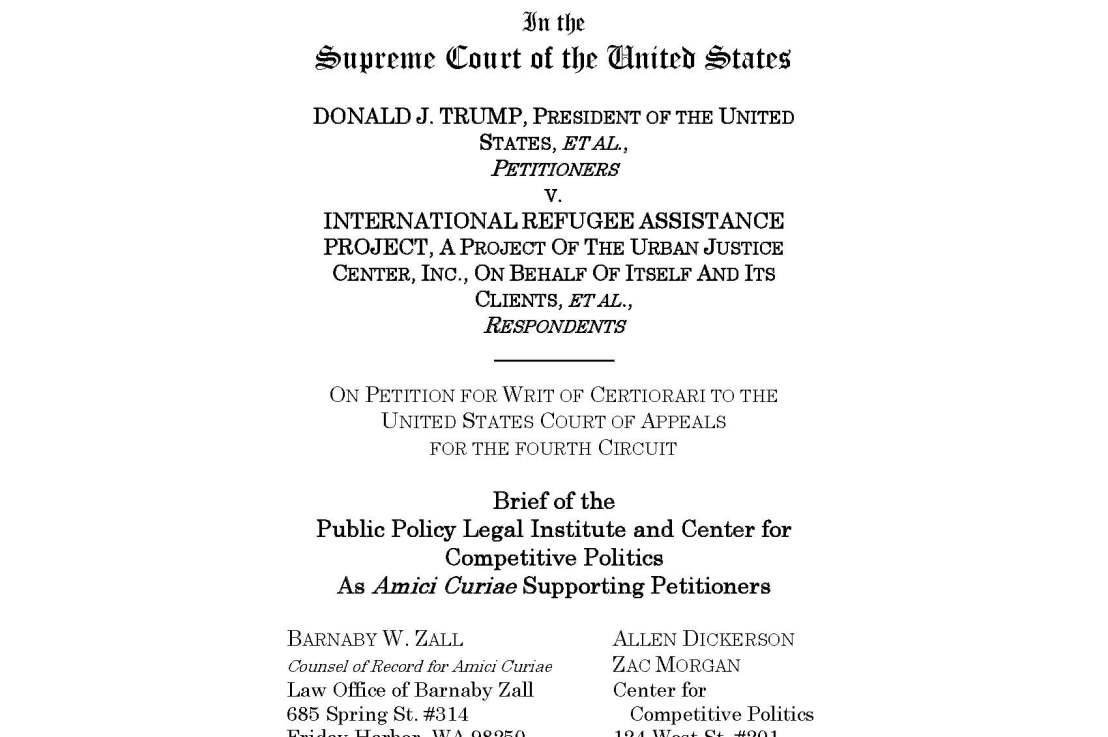
Today PPLI (along with Center for Competitive Politics) filed an amicus curiae brief  in the Supreme Court of the United States supporting a request that the Court review (grant certiorari) the decision of the U.S. Court of Appeals for the Fourth Circuit in No. 16-1436, Trump v. International Refugee Assistance Project. This case, popularly known as the “travel ban” case, is an Establishment Clause challenge to President Trump’s Executive Order 13,780 temporarily halting non-immigrant admissions to the United States. PPLI and CCP filed a brief to show the Court that there was a hidden, but very important, First Amendment speech issue in the case: whether the Fourth Circuit’s proposal to “chill” certain candidates’ speech as part of an Establishment Clause review was constitutional under the free speech protections of the First Amendment.

And here’s the CCP Press Release.

More info.