Author: barnabyzall

Alito on Free Speech

Alito on Free Speech

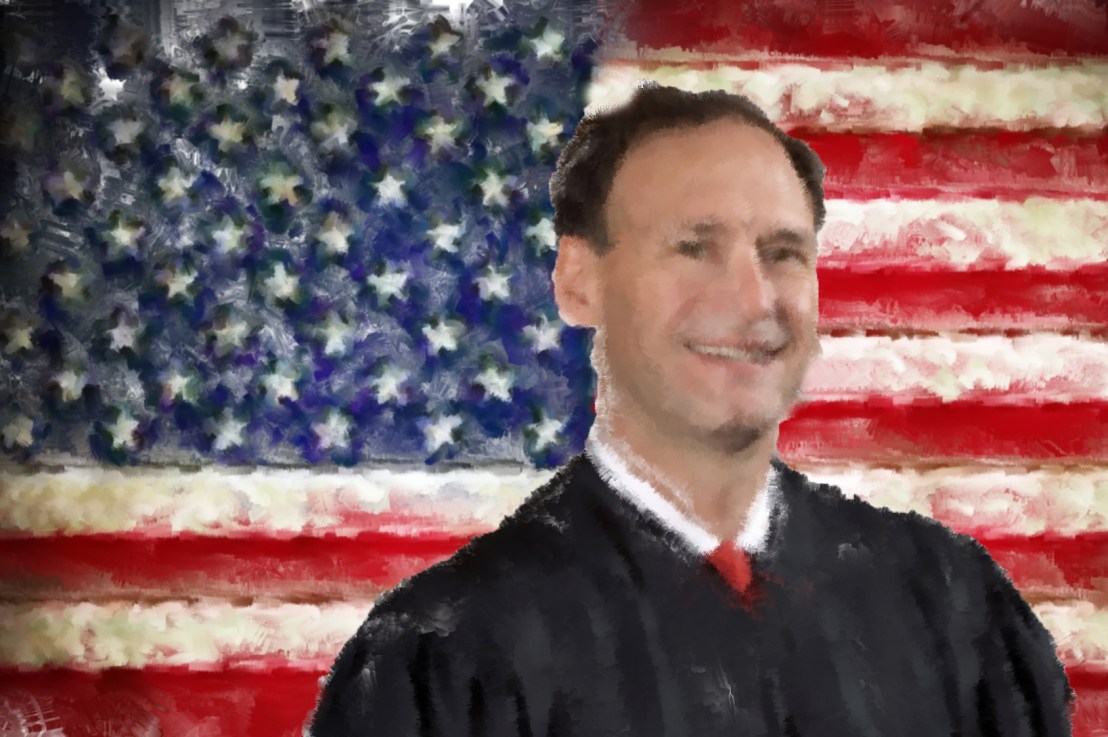
I don’t know why a little-noticed speech Justice Samuel Alito gave in February to the annual meeting of the Claremont Institute has suddenly blossomed into something to be remarked upon, but it’s always a good idea to see what Supreme Court Justices think about public policy advocacy topics. To quote Calvin Terbeek in the Faculty Lounge blog: “This is a speech worth paying attention to.”

Unfortunately, even the Claremont Institute hasn’t put out a video of the speech, having marked what had been available as “private” and thus not viewable. Fortunately, the mavens at SCotUSMap (which tracks the travels of the various Justices) have produced a partial transcript, from which these public policy advocacy-related excerpts are extracted:

Our Constitution does not give free rein to the majority. Our Framers knew very well that the majority may oppress. And therefore, our Constitution places fundamental rights beyond the majority’s reach, and the Supreme Court has the responsibility to protect those rights.

Our constitutional system cannot survive unless citizens are allowed to speak freely on issues of public importance. Freedom of speech is not a prerogative of those in positions of power or influence. It is not the property of those who control the media. It is the birthright of all Americans.

But today, unfortunately, freedom of speech on important subjects is, I believe, in greater danger than at any prior time during my life. Powerful forces want to silence the opposition. Consider this: in the last Congress, 48 Senators sponsored a resolution proposing a constitutional amendment that would preserve the free speech rights of the media elite but allow Congress and the state legislatures to restrict the speech of everybody else on any subject that came up during the political campaign, which is to say, any important social or economic problem facing the country.

This is a startling development. The very idea of amending the First Amendment is quite something. And if this amendment were adopted, freedom of speech as we have known it would be transformed.

[I]t is not comforting to see how European nations that profess to respect freedom of speech deal with the speech of the unenlightened side on cultural issues. I’ll give you two examples. In France, a group recently wanted to air a video on Down Syndrome Awareness Day. It is called, Hello, Future Mom. And in the video, children speaking a number of different languages, children with Down Syndrome speaking a number of different languages, attempt to show that they are able to live happy lives, albeit not without a lot of difficulty and sacrifice on the parts of their parents. The message is entirely positive. I advise you to view it on YouTube. I found it quite moving. You may agree with it, you may not agree with it, but that is not really the point.

The French authorities banned the video on French TV. Why? Because it was, quote, likely to disturb the conscience of women who have lawfully made different personal life choices.

Alright, you may say, this is France, they have a different legal system and a different history. Let’s move across the English Channel to Great Britain. In a leading case in Great Britain, a street evangelist named Harry Hammond made a sign that says, quote, Jesus gives peace, Jesus is alive, Stop immorality, Stop Homosexuality, Jesus is Lord. Now again, you may agree with it, you may disagree with it, that’s really beside the point.

What did Mr. Hammond do? One afternoon, he took his sign to the town square and held it up, and some of the people who saw it took offense. They attacked him. They threw mud on him, they pushed him to the ground, they tried to take his sign away. The police arrived, and they made an arrest. Who did they arrest? They arrested Hammond. He was charged with a crime and he was convicted and fined because his sign was insulting. He gave offense.

More troubling than these developments abroad is the erosion of support for free speech among the young, particularly students, and particularly college students. Students increasingly believe that it is legitimate, and indeed, essential, to ban speech that gives offense, or, to use a popular phrase, speech that makes them feel unsafe.

A recent article just within the time I’ve been here reported these survey results: a majority of high school students share this view. They think it’s right to ban offensive speech. Now where did they get this idea? The survey shows that a near majority of high school teachers also share this view.

Now, I think we should aim in our public discourse for debate that is rational, that is civil, and that is conducted in the spirit of goodwill. But important ideas are sometimes disturbing. They may offend. Self-government is not for the faint of heart. But what is going on in these schools is really a moral virus that is threatening to the future of our country. As Learned Hand aptly said years ago, liberty lies in the hearts of men and women; when it dies there, no constitution, no law, no court can do much to help it.

If the American people come to accept the views of our European friends, or the university vanguard, that speech can be banned if it makes them feel uneasy, if it gives offense, it is really hard to see how government of the people, by the people, and for the people can survive.
About that Executive Order …

About that Executive Order …

President Trump vowed to “destroy” the Johnson Amendment, which is actually the portion of IRC § 501(c)(3) that says that no charitable organization may “participate in, or intervene in (including the publishing or distributing of statements), any political campaign on behalf of (or in opposition to) any candidate for public office.”  What he signed as an Executive Order on May 4 doesn’t actually do that.

Section 2 of the Executive Order says,

Sec. 2.  Respecting Religious and Political Speech.  All executive departments and agencies (agencies) shall, to the greatest extent practicable and to the extent permitted by law, respect and protect the freedom of persons and organizations to engage in religious and political speech.  In particular, the Secretary of the Treasury shall ensure, to the extent permitted by law, that the Department of the Treasury does not take any adverse action against any individual, house of worship, or other religious organization on the basis that such individual or organization speaks or has spoken about moral or political issues from a religious perspective, where speech of similar character has, consistent with law, not ordinarily been treated as participation or intervention in a political campaign on behalf of (or in opposition to) a candidate for public office by the Department of the Treasury.  As used in this section, the term “adverse action” means the imposition of any tax or tax penalty; the delay or denial of tax-exempt status; the disallowance of tax deductions for contributions made to entities exempted from taxation under section 501(c)(3) of title 26, United States Code; or any other action that makes unavailable or denies any tax deduction, exemption, credit, or benefit.

Distilling the second sentence: “Treasury [shall] not take any adverse action … on the basis that such individual or organization speaks or has spoken about moral or political issues from a religious perspective, where speech of similar character has, consistent with law, not ordinarily been treated as” within the Johnson Amendment.

In other words, rather than permitting speech that previously has been treated as within the Johnson Amendment, this sentence says that such speech will be protected against adverse action only if it “has … not ordinarily been treated as participation or intervention in a political campaign.”

Now the important umspoken element is that the IRS already has effectively a policy of non-enforcement of the Johnson Amendment against religious organizations, as epitomized by the lack of enforcement against churches which actively promote their own violations of the Johnson Amendment during “Pulpit Freedom Sunday.” This organized effort has been going on for years. And, as Notre Dame Law School’s Lloyd Hitoshi Mayer has shown, there’s no evidence of church audits or other IRS actions against other religious organizations under the Johnson Amendment in recent years, even though the likely incidence of violations is greater than the IRS projects.

So the net effect of an Executive Order saying “all y’all keep doing what you’re doing” is to say “don’t do much at all.” Except it leaves that Sword of Damocles just hanging there. And doesn’t do what was promised.

Maybe the rest of the EO contains something more akin to what President Trump was talking about? Well, Section 1 does say: “It shall be the policy of the executive branch to vigorously enforce Federal law’s robust protections for religious freedom. … The executive branch will honor and enforce those protections.” That might, in some circumstances, be citable in court or in regulatory proceedings. But that is weak sauce, given that the federal government hasn’t actually said that it WON’T “honor and enforce” “Federal law’s robust protections for religious freedom.” And in the face of the specific directions of Section 2, that general promise is unlikely to mean much to tax law.

Same with Obamacare mandates, dealt with in Section 3, but only to the extent of requiring Treasury, Labor and HHS to “consider issuing amended regulations, consistent with applicable law, to address conscience-based objections to the preventive-care mandate.” Not sure there are even any Treasury regulations, even those applying to new Obamacare mandates, that might cover conscience-based objections.

Section 4 of the EO does require the Attorney General to issue guidance “interpreting religious liberty protections in federal law.” But again, only “as appropriate.”

Those panting to complain about gutting the Johnson Amendment were dumbfounded. The ACLU decided not to challenge it, calling it an “elaborate photo-op with no discernible policy outcome.” Even Trump supporters were “underwhelmed.” And, of course, some on both sides didn’t bother to read the EO itself.

Perhaps the most egregious response? The Freedom From Religion Foundation’s legal challenge, filed by their attorney Richard L. Bolton of Madison, Wisconsin, which was filled with typos (for example, P. 5, naming IRS Commissioner “Josh” Koskinen) and getting the EO exactly backwards. FFRF contends that it will suffer “devastating and irreparable” harm because it won’t get the same “lax” treatment as religious organizations, while the EO actually says that religious organizations will get only the same lax treatment as anyone else.

John Pomeranz, of Harmon Curran in Washington, D.C, is leading a panel discussion of the Johnson Amendment this Friday at the May meeting of the American Bar Association’s Tax Section. The panel, which was set up long before the actual text of the EO was drafted, has its work cut out for itself now. Maybe those experts can come up with some reason we and the media should be spending much more time on this non-event.

“In true Washington, D.C., fashion, this modest government program has grown significantly and now possesses great power.”

“In true Washington, D.C., fashion, this modest government program has grown significantly and now possesses great power.”

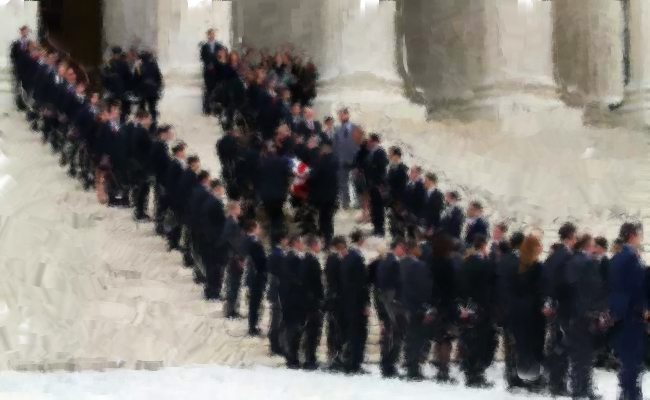
Last year, 180 of the Nation’s most influential people lined up on the steps of the Supreme Court of the United States – and you probably don’t know any of them. They lined up for the memorial service for Justice Antonin Scalia. These are clerks to the Justices of the Supreme Court, and that service generally establishes them to a lifetime career at the highest levels of the legal profession.

It also affects almost all jurisprudence in the U.S. Through a device known as the cert pool, the Supreme Court clerks control the fate of the most contentious and important cases facing the Supreme Court.

Each Justice can hire up to four clerks, usually the best and brightest of those clerking before the U.S. Courts of Appeal. The Supreme Court receives 7,000 petitions for certiorari each year, and grants, in recent years, about 75. The flow of petitions comes in huge waves with the daily deliveries to the clerks for each Justice.

In 1973, Chief Justice Warren Burger and Justice Lewis Powell established the cert pool agreement to spread the load between offices. Since 2010, all sitting Justices participated in the pool, except Justice Samuel Alito. All incoming petitions are randomly divided to members of the pool, so  a single clerk reviews a petition and writes a memo summarizing the petition for all the Justice’s offices. If a petition doesn’t catch that clerk’s eye, it likely won’t get cert. You can see the problem there; perfectly good cases can be deemed not cert-worthy by one young person’s review.

The title of this post comes from a law review article by Ken Starr, a former Supreme Court clerk, U.S. Court of Appeals judge, Solicitor General of the U.S., and dean of two universities. “The prevailing ethos is that no harm can flow from ‘just saying no.’ Self-confident law clerks can rest assured that few, if any, recriminations will attend their providing guidance to the Court to deny certiorari.” 90 Minn.L.Rev. 1363, 1376 (2006).

Although all Justices purport to thoroughly review all clerks’ memos, only Justice Alito didn’t get the pool memos; even then, Justice Alito relied on his four clerks to review 7,000 petitions. Still, that’s at least two sets of eyes on the petition flow.

Today’s New York Times reports that new Justice Neil Gorsuch has now opted out of the cert pool as well. The reporter, Adam Liptak, has followed the cert pool for many years. So now that’s three sets of eyes on the petitions.


Allison Needs Help

Allison Needs Help

It’s a busy day. Besides many other worthy topics, including those listed below, Rick Hasen’s Election Law list-serve got a request for legal comment from Allison Hayward, now a member of California’s hyper-active Fair Political Practices Commission. Hayward was formerly Vice-President for Policy at the Center for Competitive Politics, serves on the Board of the Office of Congressional Ethics of the U.S. House of Representatives, was a professor at George Mason University Law School, and was counsel to then-FEC Commissioner Brad Smith.

The California FPPC has long believed, as an institution, that it should be very active in both enforcement and penalties, and has done so repeatedly in the past. The FPPC imposes between 800 and 1,200 penalties each year. An FPPC summary of penalty decisions 1980-2014 is 286 pages long.

In practice, this means that even small paperwork violations will subject the “miscreant” to fines, sometimes substantial fines. Allison, seeing one of this type of fine repeatedly appearing on the FPPC’s agenda, looked at the authority for levying the fine. This was a $50 filing fee for an organization to register as a political committee (which in California, includes LOTS of organizations); the money is used to operate the state’s disclosure database. But with penalties, the fine could actually run as high as $5,000 per violation.

But the 1974 ballot initiative which created the FPPC forbids “filing fees.” CGC 81006 (“Except as provided in this title, no fee or charge shall be collected by any officer for the filing of any report or statement or for the forms upon which reports or statements are to be prepared.”). The 2013 statute imposing the fee states that the fee is “notwithstanding Section 81006,”. CGC 84101.5(a).

To her credit, she did not “go with the flow,” even as a new Commissioner, but asked whether the FPPC has the authority to impose those fines, and whether the Legislature can impose a filing fee “notwithstanding” the ballot initiative. She asked the mailing list readers several questions, including whether the amending statute imposing the fee is illegal because it is not “in furtherance” of the original ban on fees (a question raised by the Legislature’s own legal analysts, but ignored by the Legislature itself?

Leaving aside for the moment her substantive questions, I think it is refreshing to see a government official reaching beyond the bubble into which most officials descend on ascending to their august positions. Most comments are submitted in response to official notice and comments, but we’ve all seen numerous instances in which officials have held meetings or received comments in a nonpublic manner. I’ve recently been involved in one in Washington State where the State Bar Association, faced with a member petition for a referendum rolling back a 38% increase in Bar dues, engaged in ex parte communications with the Washington Supreme Court, blocking the referendum in an unbriefed Order. The Bar’s explanation: they needed the money.

Commissioner Hayward asks for comments at ahayward@fppc.ca.gov. If I have time, I’ll send her my take. I won’t say what that is, because I’d like her to get other comments without influence from my analysis. If you write her, please include some encouragement to reach out in this way in the future.

Hayward’s request to the list reads, in its entirety:

I want to reach out to you for help and insight on an issue in California campaign finance.  As you may or may not know, I am now on the Fair Political Practices Commission, and, yes, this is an issue that has come before us though as far as I know is not part of a specific matter before us, because I haven’t seen the agenda documents for the next meeting yet.  It is an issue on every agenda I have seen in my brief service, however, and it troubles me.

You may ask yourselves – why is she going to the Listserv with this?  After reflection it seemed the best diverse quasi-public audience for the questions I raise, and it would also seem to avoid issues I otherwise face under California’s open meeting law.  So – if you are a fellow Commissioner, don’t reply!

In 2012, the Legislature enacted (in SB 1001 – by a two-thirds vote as required for amendments to the Political Reform Act) a $50 annual registration fee for all political committees – that is, if you are something that files a Statement of Organization in California, you must pay this fee.  The law also specifies that failure to pay the fee results in a penalty of three times the fee (i.e. $150).  Cal. Gov’t Code 84101.5.  Finally, “the Commission shall enforce the requirements of this section.”  84101.5(d)(2).  The money from the fee and the penalty is dedicated to fixing the Secretary of State’s online disclosure database, CalAccess.  See 84613.

This fee was added notwithstanding Section 81006, which was part of the original Proposition 9 (1974), which prohibits filing fees.  The statute specifies it is an exception to this general rule.

In practice, the Secretary of State collects these fees and the penalties.  If the filer does not pay, the SOS refers the matter to the FPPC.  Many of these matters are then settled (via stipulation) for $200-$400 per violation.  These penalties are in addition to whatever the SOS can get, and are levied under the authority of the Act’s general civil penalty provision, Section 91005.5, which states that it applies to any violation (with some exceptions not relevant here) “for which no specific civil penalty is provided.”

But wait – there’s more.  Civil penalties under 91005.5 can be up to $5,000 per count.  How can this be?  According to staff, the “Commission shall enforce” clause kicks these matters out of 84101.5 and its limits on penalties (which are collected by SOS and go into the CalAccess fund), into the general enforcement track followed by the Commission, and its penalty provisions (which go into the General Fund).

I have issues.

For starters, there are constitutional limits (I’m thinking First and Eighth Amendments) on things like filing fees for political committees.  I believe that a $5,000 ticket for failing to pay the fee/penalty (remember this is separate from a failure to file) would trigger constitutional problems.  (The highest fees would only be imposed on defaulting respondents, since it is the practice at the FPPC to discourage defaults by imposing higher fines.)  The more common $200-$400 per count?  Maybe not so unconstitutional.

Apart from that, as a matter of California constitutional law, I am not sure the fee statute is legal.  Legislative amendments to the Political Reform Act require a two-thirds vote, but also must be in furtherance of the Act.  Otherwise they need to be in a ballot measure.  The PRA originally prohibited filing fees.  So it is unclear to me the statute is a proper amendment to the PRA.  The Assembly Committee analysis of SB 1001 raised this issue, too.

Then there’s just the plain reading.  Section 91005.5 penalties only apply when no other penalty is specified.  It seems pretty clear to me that when Section 84101.5 states that the penalty “shall” be $150, it means what it says.  The fact this fee is an exception to a general prohibition on filing fees also suggests to me that it should be read narrowly.  If you like your analysis spiced with a little legislative history, you should know that the original language imposed a $10/day fee, but the author changed that to $150 (presumably in response to someone’s constructive criticism – who knows).

Admittedly, my reading would make the FPPC’s role in these matters little more than a collection arm of the SOS.  That doesn’t seem quite right either.

So, hive mind – thoughts?