Category: Uncategorized

Allison Needs Help

Allison Needs Help

It’s a busy day. Besides many other worthy topics, including those listed below, Rick Hasen’s Election Law list-serve got a request for legal comment from Allison Hayward, now a member of California’s hyper-active Fair Political Practices Commission. Hayward was formerly Vice-President for Policy at the Center for Competitive Politics, serves on the Board of the Office of Congressional Ethics of the U.S. House of Representatives, was a professor at George Mason University Law School, and was counsel to then-FEC Commissioner Brad Smith.

The California FPPC has long believed, as an institution, that it should be very active in both enforcement and penalties, and has done so repeatedly in the past. The FPPC imposes between 800 and 1,200 penalties each year. An FPPC summary of penalty decisions 1980-2014 is 286 pages long.

In practice, this means that even small paperwork violations will subject the “miscreant” to fines, sometimes substantial fines. Allison, seeing one of this type of fine repeatedly appearing on the FPPC’s agenda, looked at the authority for levying the fine. This was a $50 filing fee for an organization to register as a political committee (which in California, includes LOTS of organizations); the money is used to operate the state’s disclosure database. But with penalties, the fine could actually run as high as $5,000 per violation.

But the 1974 ballot initiative which created the FPPC forbids “filing fees.” CGC 81006 (“Except as provided in this title, no fee or charge shall be collected by any officer for the filing of any report or statement or for the forms upon which reports or statements are to be prepared.”). The 2013 statute imposing the fee states that the fee is “notwithstanding Section 81006,”. CGC 84101.5(a).

To her credit, she did not “go with the flow,” even as a new Commissioner, but asked whether the FPPC has the authority to impose those fines, and whether the Legislature can impose a filing fee “notwithstanding” the ballot initiative. She asked the mailing list readers several questions, including whether the amending statute imposing the fee is illegal because it is not “in furtherance” of the original ban on fees (a question raised by the Legislature’s own legal analysts, but ignored by the Legislature itself?

Leaving aside for the moment her substantive questions, I think it is refreshing to see a government official reaching beyond the bubble into which most officials descend on ascending to their august positions. Most comments are submitted in response to official notice and comments, but we’ve all seen numerous instances in which officials have held meetings or received comments in a nonpublic manner. I’ve recently been involved in one in Washington State where the State Bar Association, faced with a member petition for a referendum rolling back a 38% increase in Bar dues, engaged in ex parte communications with the Washington Supreme Court, blocking the referendum in an unbriefed Order. The Bar’s explanation: they needed the money.

Commissioner Hayward asks for comments at ahayward@fppc.ca.gov. If I have time, I’ll send her my take. I won’t say what that is, because I’d like her to get other comments without influence from my analysis. If you write her, please include some encouragement to reach out in this way in the future.

Hayward’s request to the list reads, in its entirety:

I want to reach out to you for help and insight on an issue in California campaign finance.  As you may or may not know, I am now on the Fair Political Practices Commission, and, yes, this is an issue that has come before us though as far as I know is not part of a specific matter before us, because I haven’t seen the agenda documents for the next meeting yet.  It is an issue on every agenda I have seen in my brief service, however, and it troubles me.

You may ask yourselves – why is she going to the Listserv with this?  After reflection it seemed the best diverse quasi-public audience for the questions I raise, and it would also seem to avoid issues I otherwise face under California’s open meeting law.  So – if you are a fellow Commissioner, don’t reply!

In 2012, the Legislature enacted (in SB 1001 – by a two-thirds vote as required for amendments to the Political Reform Act) a $50 annual registration fee for all political committees – that is, if you are something that files a Statement of Organization in California, you must pay this fee.  The law also specifies that failure to pay the fee results in a penalty of three times the fee (i.e. $150).  Cal. Gov’t Code 84101.5.  Finally, “the Commission shall enforce the requirements of this section.”  84101.5(d)(2).  The money from the fee and the penalty is dedicated to fixing the Secretary of State’s online disclosure database, CalAccess.  See 84613.

This fee was added notwithstanding Section 81006, which was part of the original Proposition 9 (1974), which prohibits filing fees.  The statute specifies it is an exception to this general rule.

In practice, the Secretary of State collects these fees and the penalties.  If the filer does not pay, the SOS refers the matter to the FPPC.  Many of these matters are then settled (via stipulation) for $200-$400 per violation.  These penalties are in addition to whatever the SOS can get, and are levied under the authority of the Act’s general civil penalty provision, Section 91005.5, which states that it applies to any violation (with some exceptions not relevant here) “for which no specific civil penalty is provided.”

But wait – there’s more.  Civil penalties under 91005.5 can be up to $5,000 per count.  How can this be?  According to staff, the “Commission shall enforce” clause kicks these matters out of 84101.5 and its limits on penalties (which are collected by SOS and go into the CalAccess fund), into the general enforcement track followed by the Commission, and its penalty provisions (which go into the General Fund).

I have issues.

For starters, there are constitutional limits (I’m thinking First and Eighth Amendments) on things like filing fees for political committees.  I believe that a $5,000 ticket for failing to pay the fee/penalty (remember this is separate from a failure to file) would trigger constitutional problems.  (The highest fees would only be imposed on defaulting respondents, since it is the practice at the FPPC to discourage defaults by imposing higher fines.)  The more common $200-$400 per count?  Maybe not so unconstitutional.

Apart from that, as a matter of California constitutional law, I am not sure the fee statute is legal.  Legislative amendments to the Political Reform Act require a two-thirds vote, but also must be in furtherance of the Act.  Otherwise they need to be in a ballot measure.  The PRA originally prohibited filing fees.  So it is unclear to me the statute is a proper amendment to the PRA.  The Assembly Committee analysis of SB 1001 raised this issue, too.

Then there’s just the plain reading.  Section 91005.5 penalties only apply when no other penalty is specified.  It seems pretty clear to me that when Section 84101.5 states that the penalty “shall” be $150, it means what it says.  The fact this fee is an exception to a general prohibition on filing fees also suggests to me that it should be read narrowly.  If you like your analysis spiced with a little legislative history, you should know that the original language imposed a $10/day fee, but the author changed that to $150 (presumably in response to someone’s constructive criticism – who knows).

Admittedly, my reading would make the FPPC’s role in these matters little more than a collection arm of the SOS.  That doesn’t seem quite right either.

So, hive mind – thoughts?


Happy May Day, Seattle. Prepare the Hospitals.

Happy May Day, Seattle. Prepare the Hospitals.

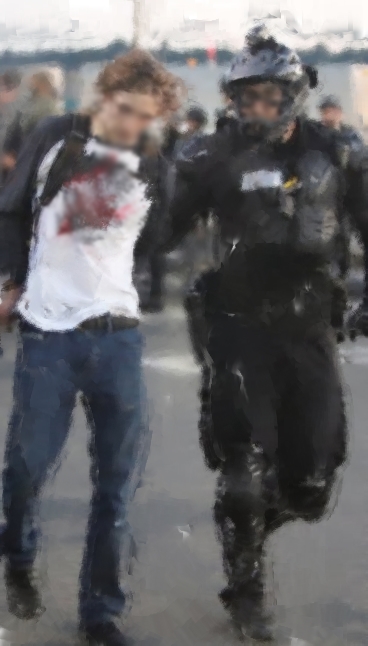
Washington state is a pressure-cooker for advocacy. “We do not believe in the validation of the state. They’re the problem in the first place,” says “Bypolar,” the organizer of a “pop-up bloc [sic] party” in Seattle to protest the incarceration of illegal immigrants and assorted other people.

Happy May Day, America. Elsewhere in America and the world, May Day is the time for peaceful protest. Not so much in Seattle. The violence by anarchists isn’t likely during the daytime marches and protests; it is expected to start after darkness falls at about 9PM Pacific Daylight Time. Normal events are canceled. Five police were injured last year, but no one has died since 2001, so it goes on. City Councilmen blame the police for the violence.

It’s odd, really, that one of the fastest-growing, economically-prosperous areas, in a beautiful setting far from the media spotlight, is boiling with violent anarchy, dissent and counter-dissent. But it happens, every year. Has for a long, long time. Usually too late for instant news coverage.

And maybe that media silence is best. After all, the most significant real effect of the violence is to make it so much harder for those of us who defend real protest and advocacy, intended to actually make a difference. So sad.

UPDATE (9:30PDT): Although there have been several clashes and arrests, things have quieted down in Seattle this evening. Heavier riots in Olympia, Washington, and Portland, Oregon.


“That’s always the problem with limits on speech: the problem of who’s in charge.”

“That’s always the problem with limits on speech: the problem of who’s in charge.”

Just as I mentioned Bruce Hopkins a couple of posts ago as a titan of tax-exempt organization law, Bob Bauer is a titan of campaign finance and election law. He is a former White House Counsel, and a decidedly partisan Democratic “sledgehammer“. But he is also one of today’s most perspicacious and even analysts, and, from his perch at More Soft Money Hard Law, sometimes turns out blog posts that perfectly frame an issue. So today.

There’s much discussion about speech limits: when are they proper (and not)? Are they ever proper? Where to draw the line?

Today Bauer points to the essential question in each of these: who decides?

Is there an exception to free speech if its purpose is to exclude from the conversation certain views or groups? …

There is a strong echo of this argument in the conflicts over campaign finance regulation. Those who would like to see the imposition of tighter limits on campaign spending … do not peg their point to the content of the paid message: It could be on any subject. But they believe that the capacity to spend heavily to promote one’s views is an act of domination over those who don’t have the resources to answer. …

The Supreme Court in Buckley v. Valeo famously rejected the notion that the speech of some may be limited in order to lift up the speech of others. … The historical record … tends to show that well-intended speech restrictions end up working against the interests of the marginalized and underprivileged. Once limits on access to a forum may be set, choices of who may spend, and how much, must be made. …

So, for progressives, the question presents itself– to whom are they prepared to cede that power to set speech limits? This question cannot be separated from the question of the wisdom of limits themselves. Limits are not all the same, and their design and administration, including any exceptions that are provided for, make all the difference. Someone has to decide. …

That’s always the problem with limits on speech: the problem of who’s in charge.

Whether or not you approve of Donald Trump as President, his election has caused many who once single-mindedly approved of limits on speech to reflect on what might happen when the “other guy” gets in power.

But then again, some didn’t get the memo. They should — and re-read — what Bauer wrote today.

UPDATE: Kevin Drum has a quick affirmation of this point in Mother Jones, titled, appropriately: “Who Decides?

A Standard to Judge By

A Standard to Judge By

“Regulating campaign speech is not easy. It’s not supposed to be.” Jeffrey Sutton, Sixth Circuit Court of Appeals, Winter v. Wolnitzek, (Aug. 24, 2016). Particularly when the speech is from a judicial election. Can a judge – or any candidate for a judicial office – say the same thing as a candidate for a non-judicial office? Maybe, maybe not. Williams-Yulee v. Fla. Bar, 135 S. Ct. 1656 (2015); Republican Party of Minn. v. White, 536 U.S. 765 (2002).

Which makes it interesting that the only current nominee for an open seat on a federal appeals bench is being attacked for getting it “wrong” in such a case. Would Amul R. Thapar, now a U.S. District Court judge in Kentucky, really “eviscerate what remains of the law limiting the influence of money on politics”, as Ian Millhauser says today in Think Progress.

Evidence? Thapar’s District Court decision in Winter v. Wolnitzek, 186 F.Supp.3d 673 (E.D. Ky, 2016) (earlier case: 56 F.Supp.3d 884 (E.D. Ky, 2014)), which Judge Sutton upheld in large part. Millhauser’s analysis is comically slanted and incoherent; he says, for example, that “much of” Thapar’s opinion “was reversed” by Sutton’s Sixth Circuit decision. But Sutton’s opinion itself begins:

The district court issued a thorough and thoughtful opinion, making
our job easier. It struck some of these provisions and upheld others. We agree with almost all of its reasoning and affirm almost all of its judgment.

Millhauser doubles down by adding: “Thapar’s logic is that speech is identical to spending for purposes of the First Amendment. But if that were true, individual contribution limits would be unconstitutional.” Well, … no, to both parts. What Thapar said was that both spending and speech are subject to First Amendment protection, and that’s certainly true. But they are different for purposes of analyzing restrictions as  the Supreme Court said in 2014:

The right to participate in democracy through political contributions is protected by the First Amendment, but that right is not absolute. Our cases have held that Congress may regulate campaign contributions to protect against corruption or the appearance of corruption. See, e.g., Buckley v. Valeo, 424 U. S. 1, 26–27 (1976) (per curiam). At the same time, we have made clear that Congress may not regulate contributions simply to reduce the amount of money in politics, or to restrict the political participation of some in order to enhance the relative influence of others.

McCutcheon v. FEC, 572 U.S. ___ (2014). Some people don’t like to recognize McCutcheon but it’s actually a fairly modern analysis of this question.

So let’s review: contributions are kind of like speech, but not exactly the same in the application. The potential for corruption is present with money, but much less for speech; that’s the real message. And you still can’t use speech or contribution restrictions for viewpoint discrimination or to stop some sources from speaking.

Like a lot of First Amendment law, it can’t (or shouldn’t) be easily boiled down to “corporations are people” or similar memes. A Prius is not a Maserati, even though both are cars. Otherwise, well-meaning analysts are mis-led. For example, the fact that some concerns affect speech and contributions differently – though both are First Amendment-protected communications – seems to have eluded Millhauser.

So, too, criticism that Thapar used “the wrong standard” to evaluate judges’ speech restrictions. People for the American Way, for example, said: “Judge Thapar ignored Supreme Court precedent and, without meaningful analysis, applied “strict scrutiny” (the highest level possible) to the contributions ban.” To its credit, PFAW not only mentioned McCutcheon, but quoted it. Their take was different though, citing McCutcheon for emphasizing a “lower, but still rigorous standard of review.”

So this “without meaningful analysis” criticism turns on the new “exacting scrutiny” standard for review of certain campaign finance restrictions. See, e.g., Buckley v. Valeo, 424 U.S. 1, 26-27 (1976). And what does McCutcheon say that standard is? The restriction may be constitutional “if the State demonstrates a sufficiently important interest and employs means closely drawn to avoid unnecessary abridgement of associational freedoms.”  134 S.Ct. at 1444.

Sigh. It’s another one of those Prius/Maserati issues as well, noted in the Sixth Circuit opinion: “While ‘[j]udicial candidates have a First Amendment right to speak in support of their campaigns,’ Williams-Yulee, 135 S. Ct. at 1673, they do not have an unlimited right to contribute money to someone else’s campaign.”  That’s what PFAW was looking at as “meaningful,” I guess.

But Thapar’s analysis was meaningful and precise; he did not cite McCutcheon, but he could have, since he actually worked through both parts of the McCutcheon test quoted above (though he took them in reverse order).  First, was there corruption or the appearance of corruption from the contribution? No, because the corruptive aspect (“preventing bias against litigants”) was the same whether the candidate simply said “I support the Democratic party” or contributed to the Democratic party. Second, the State (through its Judicial Conduct Commission) was asserting that it wanted to diminish the speech of particular parties through this restriction; and here, the word “party” is apt, since the Commission’s actual statement of its interest  was:  “Kentucky’s compelling interest in diminishing reliance on political parties in the election of judges”. So by its own admission, the State’s purpose was not to avoid corruption (restriction permitted), but to diminish the role of specific speakers (not permitted).

The Sixth Circuit did reverse Thapar on this point, but it did so by, in essence, pointing out that he applied the second McCutcheon test on the wrong party. The State wanted the parties’ silence, and was using the judges’ contributions as a tool for doing that. The Sixth Circuit said, pretty much succinctly refuting PFAW’s complaint:

Financial contributions, we realize, amount to speech. See Buckley v. Valeo, 424 U.S. 1, 17–18 (1976). But the alignment between speech and money makes a difference only with respect to Janus-faced regulations that tell judicial candidates to run for office but deny them the tools for doing so. That is not what this regulation does. A contribution of time, money, or reputation to a political organization or a candidate in a separate election, whether judicial or not, differs in kind and degree from a judicial candidate contributing the same to his own campaign. There is “a dividing line between” the speeches clause, “which impermissibly bars protected speech about the judge’s own campaign,” and the contributions clause, “which addresses a
judge’s entry into the political arena on behalf of his partisan comrades.” Siefert, 608 F.3d at 984. Kentucky, for this reason, allows judicial candidates to purchase tickets to political gatherings only if “he or she doesn’t create the impression that the purchase is not for the advancement of the judge or candidate but is solely a contribution to another candidate or political organization, which is prohibited.” Canon 5(A)(2), Cmt. The contributions clause narrowly serves the Commonwealth’s compelling interest in preventing the appearance that judicial candidates are no different from other elected officials when it comes to quid pro quo politics.

Also a meaningful and precise analysis. Just looking at different aspects of the same question. Oh, and starting out with a very specific statement that must drive Millhauser and PFAW up a wall: “Financial contributions, we realize, amount to speech.”

So why attack Thapar for what is, in fact, a pretty tough call? Oh, just politics. I have no personal knowledge about whether he is qualified for the Sixth Circuit and really have no opinion. But he sailed through his Judiciary Committee nomination.

But let’s not use the guy to make some sort of case that campaign finance challenges won’t get a decent hearing in his court panels or that “money is not speech.” Thapar seemed to the rest of the Sixth Circuit to have “issued a thorough and thoughtful opinion” in the one case his opponents have raised.