Why Is Everyone Angry with Ellen Weintraub?

Why Is Everyone Angry with Ellen Weintraub?

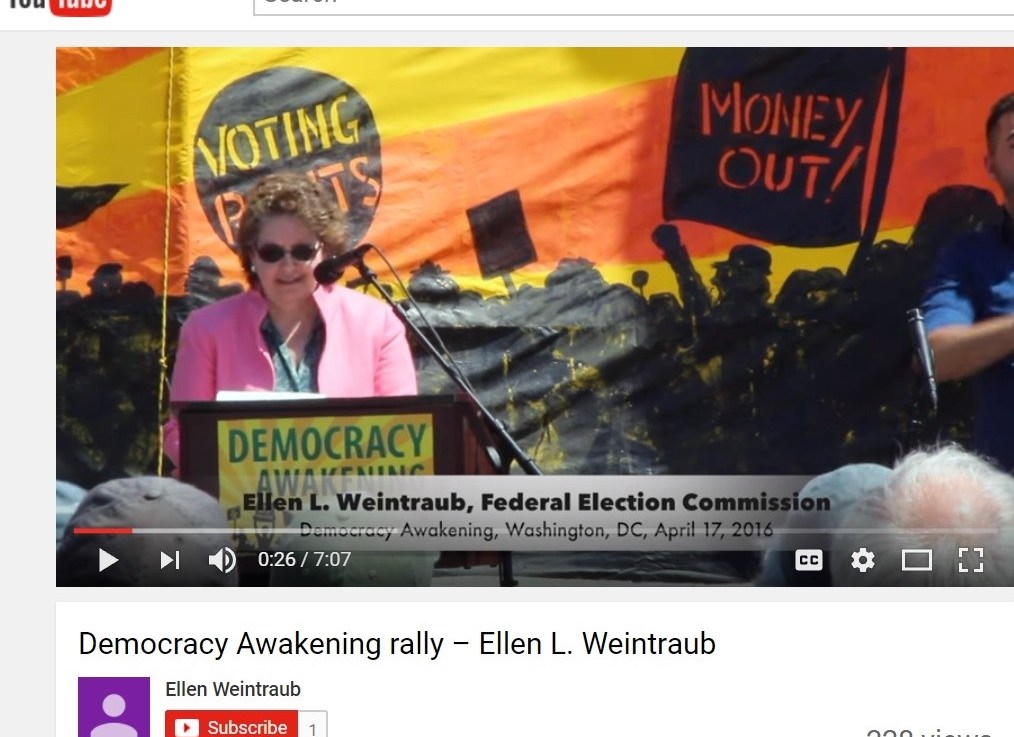
There’s a new controversy over whether Ellen Weintraub, who has been a Federal Election Commission commissioner for 13 years (ten of which as a hold-over after her term expired because they couldn’t find another Democratic nominee), should step down. It started on Feb. 10, when Weintraub issued a statement on FEC letterhead challenging President Trump’s claims of voter fraud in New Hampshire, escalated when Cause of Action, an outside investigatory organization, filed a request for the FEC Inspector General to determine whether Weintraub’s statement violated federal law, and became ridiculous when Weintraub shouted that she would not be a victim and began posting YouTube videos of herself leading chants at anti-Trump rallies (although only 228 people have viewed it). Bob Bauer offered a defense, but it was much more an attack on Cause of Action (“funded by the Koch Brothers”! Oh, horrors!) than a substantive buttress of Weintraub’s position.

Now former FEC Chair and current law school professor Brad Smith, who also helms the Center for Competitive Politics, has called for Weintraub to resign. Smith cites a variety of Weintraub’s mis-steps, but concludes that she has now disqualified herself for a variety of FEC inquiries. “When Commissioner Weintraub engages in ad hominem public attacks on the lawyers representing parties before her agency, repeatedly criticizes the President on matters outside her jurisdiction — or worse, within it — speaks publicly about pending MURs, and announces in advance her views on issues she will have to vote on, it is a problem, not just for her and the Agency she represents, but for the American public.”

Weintraub is a sad story and really should go or be removed. But the reality is that the FEC already has one vacancy, left when Ann Ravel left her seat on the Commission. Ravel, like Weintraub, engaged in inappropriate behavior, including saying that “my role in the commission is not to apply constitutional principles”, and even irked moderate members of the Commission.  Her position has not been filled.

There’s an old adage in politics, that “you can’t beat somebody with nobody.” The most recent presidential campaign may have undercut that wisdom, but the point is that Weintraub is not likely to resign. She will have to be replaced. Let’s hope it gets done sooner, rather than later.

Mike Engle Joins ACT

Mike Engle Joins ACT

The IRS just announced that Kansas City CPA Mike Engle, from the firm BKD, will join the Advisory Committee on Tax Exempt and Government Entities (ACT). ACT presents reports and recommendations to IRS leadership, and includes ten practitioners from a variety of exempt organization backgrounds.

I’ve had the pleasure of working with Mike for several years, and have found him extremely knowledgeable about EO issues. An old expression is “CPAs wear gray,” as in bland and hide-bound, but I’ve always found Mike receptive to exploring new ideas and structures in exempt organizations. His biggest concern, as it should be, is that the organizations comply with the rules, but he also takes the time to explain why the rules exist and how they’re interpreted.

Congratulations to Mike Engle.

Advocacy? Don’t Do That Again!

Advocacy? Don’t Do That Again!

So a couple of stories about successful advocacy groups being chastised for being successful:

First, the Milwaukee Journal Sentinel, relying on hacked records, gasped and reported that the Lynde and Harry Bradley Foundation from Milwaukee “has been quietly using its vast resources to construct state-by-state networks of activist groups to win support for its conservative agenda from coast to coast.” The Bradley Foundation was following the blueprint (actually a book entitled: “The Blueprint: How the Democrats Won Colorado”) of a Colorado group called “The Gang of Four” a decade ago. And in Wisconsin, the Bradley Foundation has similar liberal opponents such as One Wisconsin Now and Emerge Wisconsin. The Journal Sentinel’s story is a lengthy account of the growth and strategy of the Bradley Foundation, and worth a read.

And in the same vein, Turning Point USA, is an organization that supports conservative candidates for college student government offices. The Chronicle of Higher Education reports that the organization’s success has now drawn fire from those who believe  Its leader, Charlie Kirk, is described as a rising star, but the organization itself has become a flash point for opposition to conservative candidates on many campuses, including the University of Oregon where the number of colors on a campus organization’s expensive T-shirts was a major source of contention.

This is What Aggressive Campaign Finance Enforcement Really Looks Like

This is What Aggressive Campaign Finance Enforcement Really Looks Like

In 2013, Susan Shelley was a first-time candidate for a California legislative seat from Orange County. California has one of the most complicated and draconian sets of campaign finance laws in the country, and one of the most aggressive enforcement agencies in the Fair Political Practices Commission.

FPPC Chair Jodi Remke wrote last year that California’s 1974 Political Reform Act “is overly complex, cumbersome and sometimes contradictory.” She noted that elected officials claim any errors they made were a result of the law’s complexity, and potential candidates in smaller races are deterred from running when faced with the intricate rules.

Shelley, by the FPPC’s own account, “substantially complied with the Act’s campaign reporting requirements,” made a “good-faith effort,” and “consulted Commission staff throughout.” Further, they found “no evidence of deliberate concealment or intent to deceive the public.”

Nevertheless, she acted as her own Treasurer, and made what the FPPC must believe was a grievous error: although she submitted her electronic campaign finance filings on-time, she failed to mail in paper copies of the same filings on time.

How difficult are the California campaign finance laws to comply with? The FPPC attorney who filed the 55-count FPPC complaint against Shelley made a simple mathematical error and double-counted funds transferred between the two committees Shelley was required to establish.

The potential penalties? $55,000. No word on whether the complaining attorney also faces a penalty for an incorrect filing.